Wednesday and Thursday both consisted of meals, Holy Mass, and two lectures. Amidst this schedule, I have had multiple opportunities to get to know my fellow classmates and the summer student workers, as well as spend time in prayer in the Chapel. Each time that I study, I try to find a new spot on campus: a bench under a tree, a solid wood desk in the student lounge, a hammock with a clear view of the full moon (had to use a reading light for that one). I am so thankful that I have been able to settle here at TMC and feel comfortable and at peace. I am also graced from time to time with little reminders that the Lord has a plan for me here and abroad; and so am I able to be present to the moment, soaking up each bit, unafraid of the future unknown.
"Formation of Catholic Culture in Britain" ~ with Dr. William Fahey
Our morning lecture Wednesday was led by the President of Thomas More College, Dr. William Fahey. He began by introducing us to the three main devotions of the English people: devotion to Our Lady, to St. Michael the Archangel, and to the Apostles, specifically Sts. Peter and Paul. Dr. Fahey described the spiritual battle between the two missionary groups, the Irish Church and the Roman Church, in what we now know as the United Kingdom between the third and eighth centuries, and how these groups found unity in Sts. Peter and Paul.
The central theme of Dr. Fahey's lecture was ruin; the fragility of things human, the transitoriness of life, and the general pattern of English civilization as a passing away from greater to lesser times. Dr. Fahey found this theme to be succinctly summarized in the first line of the Anglo-Saxon poem, "The Battle of Maldon": "...it was shattered." The British people understand their land as descendant from broken cities and culture, a sort of remnant, a fragile gift, the "inheritance of people taking the last stand." Power and wealth lead to arrogance, which leads to forgetfulness of the past, of memory, and of tradition, with then leads to sleepiness. Dr. Fahey explained that England now is in a state of severe drowsiness and needs to be roused [much like the United States]. We listened to recordings of speeches of Winston Churchill and King George VI (aka the king from the movie "The King's Speech) harkening their beloved countrymen to the memory of the past and encouraging them to recognize their dependence upon God.
Beowulf Seminar ~ with Dr. Mrs. Fahey
 |
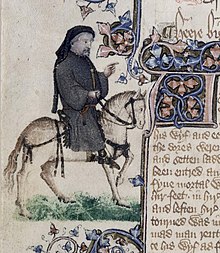 |
| Canterbury Tales |
The morning lecture on Wednesday was given by Dr. Kalpakgian - who turns out to be the father of Mr. Mark Kalpakgian, the Director of Student Life of the Austrian campus during my semester in Austria. Funny how little things come full circle. Anyways, we started off with the Prologue of The Canterbury Tales, which my classmates asked me to read again :P This time, we studied the Prologue in-depth and brought out the underlying themes. The Prologue introduces us to the characters, of course, but also to human nature as it is, and reminds us of the human condition. The Prologue is, in essence, a "microcosmic portrait of humanity," to quote Dr. Kalpakgian. We are all on a journey, a pilgrimage, towards a common destination, and we all find counterparts of the Canterbury characters in our own lives. Human nature is good, but fallen, and people do not always live balanced lives. As C.S. Lewis and J.R.R. Tolkien creatively show in their fictional characters, we are twisted, bent.
Additionally, we looked at the Christian understanding of the nobility of work and the importance of having a good sense of vocation. As students, we may take the "clerk of oxenford" as our example of vocation: "gladly wolde he lerne, and glady teche." In other words, we must have dedication to the task of learning and the eagerness to share what we have received through our education. If you are in the right vocation, you will do it cheerfully out of love and be willing to make sacrifices.
For our next topic, we explored the theme of the knight. We took for our examples the Knight in the Prologue of Chaucer's Canterbury Tales, the flawed knight Arveragus in the Franklin's Tale, and Sir Gawain. Out of this exploration rose some important truths. Sometimes, good and evil need to confront each other; good cannot live in ignorance of evil, and vice versa. Trials are necessary in order to test us, to dig beneath the surface level, in order that we may grow.
Finally, there were two shocking realizations for me during this class. The first is the comparability of courtly love to modern, cohabitating love. Both are threats to Christian marriage, and both take the premise that there is no romance in marriage. For these two flawed notions of love, romance only occurs outside of or before marriage. In marriage, expressions of love are predictable, boring, and restricted. The second exciting discovery was that the authentic knight demonstrates true manhood and true bravery in his challenges and battles by his faith, his trust in Divine Providence - "whatever the consequences, come what may." The true knight does not artificially orchestrate a battle to favor himself, for he does not fear the future or the unknown; his life is in the hands of his Maker and his Lord.
"Merry England" ~ with Dr. Blum
 This Thursday afternoon lecture began with one of my favorite topics: Marian devotion in the Middle Ages. We read a 15th century Marian lyric and briefly learned about medieval expressions of Marian piety, specifically observing Marian feast days and making pilgrimages to statues of Our Lady (for example, Our Lady of Walsingham - see image below). We then explored the communal basis of Christian life as made evident in the medieval village system and open field system. On my part, I finally understood the English obsessions with hedgerows and cows as recurring literary subjects. Dr. Blum gave us a more accurate understanding of the Catholic Church's struggle with secularization in the 14th century. At the end of the class we compared Robin Hood and the Sherwood Forest to Beowulf and Heorot, Hrothgar's great mead-hall. From this, we demonstrated that liberality, the disposition to give gifts in good measure, leads to friendship and fellowship, which, when combined with a central place of gathering, knits community and fosters human happiness.
Glory to Him.
In Christ through Mary,
Victoria
 |
| Explanation of the Image of Our Lady of Walsingham |

No comments:
Post a Comment